Tuesday, October 5, 2021

A poor farmhand

The farm-worker

The farmhand Alfred from Emil in Lönneberga.

Most people in Sweden will probably think of Alfred in Emil in Lönneberga or Robert Nilsson in Willhelm Moberg's Emigrant Series when they hear the word farmhand. Of course, the image of Alfred and Robert Nilsson as a farmhand is a bit embellished, but there are great features of how the farmhand felt at the time in these two series.

A farmhand, a service servant or Lego servant (tjänstehjon and legohjon in Swedish) as it was also called had conditions that were regulated by the Lego servant Statue between 1664 and 1926 (with certain changes over the centuries) which in practice meant a general duty to seek and find a master who wanted to hire. Of course, there were a few exceptions for the wealthy, for young people up to 21, if their work was needed on their parents' farm and for people who were unable to work. An employment as a farmhand with a farmer was valid (after 1833) between 1 November and 24 October with mutual right of termination on 24 August. Service as a farmhand (as well as a maid), was the vocational training available to those who did not learn a craft as an apprentice.

The contract statue from 1877 from the law of the Kingdom of Sweden states, among other things.

Section 10 § servant shall in his relationship be godly, faithful, diligent, obedient, sober and moral and shall not shy away from the work and chores that the master reasonably undertakes. If the servant is negligent, stubborn, or indecent and cannot be corrected, or if it turns out to be unfaithful, ignorant or otherwise incompetent in the service, it may be separated from it by loss of the entire salary, and receive such a grade as it deserves; also compensated for the master's damage, which he performs in court.

Section 52 § If a servant deviates from service earlier than service time is out or it has done all the work, the master has the power to collect it again by force, and becomes a service servant in the service until the day of moving, and loses half the salary and the damage.

In today's situation, it would have been the employer who would have been prosecuted if he had fetched a worker by force.

Maybe sort out the concepts a bit too?

Service servant (or Lego servant) in agriculture were called farmhand and maid respectively. The Lego servant Statue regulated the service servant's obligations and rights towards the master in Sweden.

Dependent tenant (Inhyseshjon in Swedish) were work incapacitated and unmediated people, usually the elderly or people with disabilities, who were placed by the parish's poor care, "housed", with a family for compensation. It was a solution in places where there were no poor houses or other public institutions for the poor. The dependent tenant was placed with the family that demanded the lowest payment to house the tenant.

Rotehjon (or pauper) were the most unfortunate, they were not allowed to remain as pauper in any family but were referred to rotation throughout the parish. For shorter periods, they were allowed to stay in each place, where they received the necessary food, accommodation and care. Rotehjon did not even get peace and rest when they lay on the deathbed. It was considered bad luck to have a dying rotehjon in the home, so they were sent around between different homes when they were dying.

My grandfather's grandfather had a dependent tenant during the 1880s and also my grandfather's father had a couple a bit in the early 20th century. How did it happen, you may be wondering? After all, they were footsoldiers and they had many children. Sometime during the second half of the 19th century (probably during the 1870s) a new soldier's croft was built for the Lantz soldiers at 123 Håkentorp (the croft was demolished when the house that stands there today was built), but the old soldier's (it is now in Götarps Brunn) croft was not moved immediately but had to stand. For a soldier who was not always in such a good position moneywise, it was good if they could get a little extra money to house a person or two.

Were there any servants in the family then? Yes, there were a few actually and some of them moved to America. Everything was not as romantic as many people think today, but it was a struggle from morning to evening for the servants.


The maids

The farmhand Alfred and the maid Lina from Emil in Lönnerberga.

For many women, there was not much of a  choice than to become a maid.

Maids who worked in agriculture belonged to the farm's servant and were the female equivalent of the farm's male farm boys. On small farms, the maid often did both housework and farm work, but on larger farms, mainly the southern parts of Sweden, there could be a number of maids who only did farm work, such as milking, while special maids did housework.

Maids who worked as maidservant in the home were called pigor in Swedish but also called jungfru or tjänarinna, were either subordinate to an employed housekeeper or housewife, or also directly subordinate to the family, then often under the wife's directive. The word "maid" was given a low status. For domestic girls in the cities, the word was replaced by a servant girl around 1919, while a childrens maid increasingly became a nanny.

In noble manors it was customary for both maids and maidens to have their weddings paid for by the employers, who also held them in the manor party room, a custom which was reflected in the fact that a noblewoman who was the court mistress also had her wedding paid for by her royal employer and the wedding held at the Royal Palace. The daughters then dressed the bride, and the employer family often attended the festivities. This was part of the informal charity that the nobility was considered to have to show towards their servants and corresponded to the financial responsibility that could be taken for elderly "faithful servants", and was repeated in the other celebrations that a noble family traditionally held for their servants during various holidays like midsummer, when they themselves participated in the dance to illustrate a form of family relationship within the household.

A maid did not earn much in cash because most of it was paid in kind. On average, a maid in the countryside earned half or two-thirds of what a farmhand earned. It was not considered that women needed money as much as men. In the cities, the maids earned more, which was one of the reasons why the maids moved to the cities.

Just like the servants, the maids obeyed under the Lego servant statue. It was written on the employer's terms. He managed the time of the servants. On the so-called maid Saturday when the maid was to be free, she had to negotiate with her master, and for a week in the autumn around Mikaelsmäss at the end of September, the servants had a week to look for a new and perhaps better place to work.

When you look more closely at how they lived in the past, today we have a hard time understanding how they could cope with the conditions that prevailed at that time. It is difficult to get acquainted with their everyday life. People usually talk about humane things but may not always understand that what they consider to be humane today may not be humane in a hundred years or that it may have been unthinkable a hundred years ago. Society is changing and many times for the better.

//Daniel

Saturday, October 2, 2021

The Törestorp family


Törestorps Mellangård as it looks today.

After being in Törestorp and looking at the farm there plus talking a bit with the people who lived there now, I thought it might be fun to write a little more about the part of the family that once lived there. After all, my grandmother's family lived in Törestorp for about 150 years, between the early 17th century and the middle of the 18th century.

Since I already wrote about the first in the family at Törestorps mellangård in my previous post, I thought I would continue from there:

Lars Assarsson owns and manages half of the tax home Stackebo, Gnosjö. He bought the farm from his father Assar Arvidsson in 1619.

The use of the farm seems to have been relatively extensive and from the cattle lengths in 1638 it appears that they had 2 oxen, 10 cows, 4 heifers, 6 old sheep and 12 young sheep, 1 piece of rice, 6 old goats and 14 young goats and 1 old pig. The seed consisted of 5 barrels.

In 1634, Lars Assarson and his brother Filip Assarsson sell a sister plot in Törestorp Mellangård to sister Elin Assarsdotter for 58 daler "good common coin". Probably, however, Lars Assarsson still has one and a half sister lots in Törestorp Mellangård.

Lars Assarsson is sometimes a committee member at so-called district councils. Lars also appears as a signer of the mantle length, which means that he was probably the church's sixman (prefect in todays language).

At the autumn session of 1664, Lars Assarsson, together with the parish priest Bergerus Colliander in Åsenhöga, requested that the shepherd or forest ranger and some committee members inspect some "harmful" oaks in their fields.

The barn to Törestorps Mellangård what it looks like today.

Jöns Larsson, Approximately 1610 - 1677, Homeowner in Törestorp Mellangård, Glazier, committee member, Member of Parliament.

1656

According to the court book (Västbo renovated court book (9b), VT1656) Jöns [Larsson] glazier in Törestorp buys the following parts in Mellangården:

- 1 sister lot by Lars Filipsson, Kallset, Jöns Filipsson, Målskog and Marit Filipsdotter, Högshult, which makes up 1/9 of the entire farm.

- 1 sister lot by Jöns Larsson and Lars Jönsson, Bränneshylte, for 16 rdr

- 1 sister lot by Karin Arvidsdotter in Gynnås (through her husband Per Jonsson), for 15 rdr

- 1 lot by Ingrid Arvidsdotter, for 15 rdr

- 1 part by Arvid Arvidsson in Hästhult, for 30 dlr. The purchase has been blamed by Arvid on the previous thing, but a settlement has been made where Arvid gets another 4 rdr.

Assar's son is Lars Assarsson in Stackebo and his son is the above-mentioned Jöns Larsson in Törestorp, which is explicitly stated at the autumn session 1665 (Västbo AI: 4) "... in Thörestorp, sent his son Lars Assarsson, who is in wittnes' writings most emphatically introduced men now dead ... "

See: Göta Hovrätt - Advokatfiskalen Jönköpings län EVIIAAAC: 10 (1659-1665) Bild 810 (AID: v190286.b810, NAD: SE / VALA / 0382503)

Assar Jönsson 1640 - 1724, Glazier, sixman. Became at most 84 years old.

Olof Assarsson, 1678 - 1762, dies at Törestorps Östergård

This is where the family's regime in Törestorp dies out. During this time, not only the middle farm has been in the possession of the family but also the east and the western farms.

Being able to follow several generations in one place can often be very fun, although it is also fun to see them spread out in the different parts of the landscape. From what I have seen, the different genera are usually concentrated within a certain region. Of course, people came in from other areas that I wrote about in previous posts and that I will certainly write about in the future as well.

You who belong to the different families can of course contact me if you have stories that you have heard about different relatives so that they can be preserved for future generations. They would probably be happy to read about the family even then.

//Daniel

Going back in time part 3 The second coming

During the summer of 2018 it was time for a journey back in time again. It was time for a few other places and other parts of the family this time.


Västra Lägret or Western Camp

Exhibition of a soldier's cabin at the Miliseum

The first place you ended up at after a small coffee with a relative (a cousin of my mom) in the morning was Västra Lägret (Western Camp) in Skillingaryd. From the 1680s onwards, it has been a military training ground. Several generations of footsoldiers and other soldiers in the family have practiced in this very place when they were not out in the field and fighting, of course. It is still sometimes used as a training ground for the military, even though it may not be the same as before. There is now also a military history museum which they have shortened to the Miliseum.

My great-great-great-grandfather Jonas was 203 centimeters tall and I am barely 170 centimmeters tall and I had to bend down to get into the croft that he used to live in as a soldier!

The inside of a soldiers cabin.

In addition to the practice field, there are also some buildings from bygone times. Barracks, exhibition hall, croft and other buildings are today in the area and many of the buildings were built during the second half of the 19th century. From the beginning, the soldiers were allowed to sleep in tents in the area before the barracks were built and they ate out in the open. It's a little special to go where even your ancestors once went.

Because we had stopped at a cousin of my mother before we went to Västra Lägret, we were late and we went straight to an aunt of mine (on my fathers side) from the Miliseum to have lunch, which was also very nice.

After lunch with my aunt, the journey continued.

Törestorps Mellangård (or Törestors Middlefarm)

The house as it looks now in Törestorp.

Törestorp's middlefarm belonged to the family on my grandmother's side (fathers mothers side) once upon a time.

The first in the family to live here was a man named Assar Arvidsson and he was born in 1555 in Stackebo outside of Gnosjö. It is not really clear when he moved here for the first time but it may have been during the early 17th century so his son seems to have been born right here in 1610. The family lives in 1613 in Törestorp Mellangård, Kulltorp, but is in 1614 and 1615 in Målskog, Kulltorp, to live in Törestorp Mellangård again in 1616. The family also owns Stackebo, Gnosjö. I will return to Stackebo in particular a little bit later.

Exactly how they came to own Mellangården is a long story, but I will try to summarize it here:

In his capacity as Knight Chief, Assar Arvidsson is the commander of a fänika. Throughout the 16th century, Fänikan is the highest unit of infantry and consists of up to 500 people. At the beginning of the 17th century, the fänika became smaller and then got the name company.

Assar Arvidsson participates in the wars in Ingermanland and Livonia. He probably also took part in the battle of Stångebro in 1598.

During a stay in Livonia, Assar Arvidsson is accused of killing Peter Götarsson. He frees himself from this accusation through a twelve-man oath, which is taken at a court in Brödrahalla 1604-10-12 (Västbo 6, Laga ting 1604-10-12).

The restoration of the castle in Jönköping is something Charles IX shows great interest in, as this is an important part of the defense against Denmark. In 1610, the captains Assar Arvidsson and Håkan Assmundsson were ordered by the king to participate with their footsoldiers in "completing the building at Jönköping Castle". Both captains are told to be on site, to ensure that the footsoldiers perform the work "on purposely" and that they "do not commit any negligence".

In 1611, Assar Arvidsson was dismissed from his post as captain by Charles IX. It is stated that Assar "for age and long service" can no longer perform his "office". Conditions for dismissal, however, are that in the "commenced feud period" against the Danes, if necessary, he gathers the common people in Västbo and adjacent districts and "most of what is possible for him" prevents the Danes.

In connection with the dismissal, Assar Arvidsson receives "for his long and faithful service" during his lifetime freedom from all annual taxes "certain and uncertain" for his farm. The royal letter explicitly forbids "bailiffs or scribes at the same place who are now or will come in the future can make him an obstacle or a acquisition".

During the war, the Danes attack Jönköping but are forced in 1612 to retreat along the Nissastigen during very difficult ravages for the population. More than 200 farms are burned. The defense in Västbo is probably organized by Assar Arvidsson.

In a royal letter issued by Charles IX and dated in Värnamo 1613-01-17, he is granted Törestorp Mellangård, Kulltorp, by a letter. This is probably a confirmation of the right he already received at the dismissal of 1611.

In 1619 he sold Stackebo, Gnosjö, to his son Lars Assarsson.

1613 Assar Arvidsson receives a royal deed of grant at Törestorp Mellangården.

In order to move forward in time in this family line, it is only in the 18th century that the history of Törestorps Mellangård ends for the family. It is in the 1740s that the last person to die in this family who lives right on Mellangården, but that is not the end for the family in Törestorp. In the 1760s, the last ones die in Törestorp, but then it is not in Mellangården but then it is in Östergården. Västergården in Törestorp was also owned by the family for some time.

By this time, the family had had time to spread out a bit, including to Christergården in Kärda, Södra Unnaryd and Kvarnabo. For a cousin of mine, it is certainly fun to hear that Kvarnabo has belonged to the family once upon a time when she lives right there now with her husband. On 21 December 1723, Anna Olofsdotter was born in Törestorps Östergård. I do not know at the time of writing if she married or if she had children or something like that but I know that she died on May 7, 1798 in Kvarnabo. One thing that is funny in the story is that my cousin's husband's grandfather was born in Kvarnabo!

Stackarp and Stackebo

Now we are going further back in time than the family in Törestorp. We are going to the earliest born in the family on my grandmother's side (fathers mothers side) and the earliest born that I have found in any family line. The first indications I got about this man, he would have been born in 1529, ie 6 years after Gustav Vasa became king of Sweden. His name was Arvid. At this time the documentation of born, dead, married and such was not specially developed here in Sweden but it would develop more and more during 160 years until the 1680s when it was established that the priests would document those who lived in the parishes, but in some places it could take a while into the 18th century before everything started in any seriousness.

Arvid was born and raised in Stackarp which was "next door" to Tyngels village in Kulltorp. In 1619 he is said to remember more than 90 years back in time, which indicates that he was born in the middle of the 1520s. Another interpretation is that he might be 90 years old but this is debatable.

Arvid has been a board member in Västbo district court for over 40 years and is documented as such at least from 1589.

Arvid or his wife has an inheritance in Beckhult, Källeryd, and possibly also in Österskog, Kulltorp.

In 1619 there is a dispute where Mrs. Brita in Aggarp and Erik Månsson to Herrestad had a croft built, Lövön, under Herrestad, despite the fact that Lövön traditionally belongs to Västbo. In connection with this dispute, Arvid testifies:

"... that the time he was a boy and a farmhand who lived in Tyngel would have his sister then he followed them in Tyngel into Lövön, and peeled bast, and it happened with the praise of all of them, as in the village of Tyngel. were, item that he never other of his old parents, heard or perceived oats than Lövön of the heath high and ancient times, oats listened and lay to Tyngels village, where up he made his oath of bliss on the law book ". (Västbo: 6, ST1619, No. 8)

To peel bast is to take the bark from trees and the like that you could sell and make money on during this time.

Arvid is also a member of parliament.

I searched for Stackarp for a month and a half but could not find it even though I asked around in local associations, facebook groups and looked elsewhere. It can be very difficult sometimes to find places that are 500 years old but it is never impossible. It will just take a little longer to find it!

View from Stackebo.

After he had lived outside Tyngel, Arvid moved to Stackebo outside Gnosjö and this is where he became a Member of Parliament.

Exactly when Arvid moves to Stackebo outside Gnosjö I do not know but one guess is that he moves there in the early 1550s.

Bårebo

For a while, my grandmother's parents (my mothers mothers) lived in Bårebo. They had married on December 30, 1905 in Byarum and first lived together in Svenshult in Åsenhöga Parish before moving to Bårebo just a short distance from Gnosjö on August 1, 1906. On August 30 of the same year, their eldest child and first daughter was born. Alva. After having been employed by the manufacturer Boreus in Gnosjö for several years, he bought Svenshult in Åsenhöga, where he and his family moved in 1914. Now they also had their son Herbert with them, who was born on March 3, 1910. On May 11, 1917, their third and last child was born and this time it was in Svenshult that the child was born. The name of the daughter became Kerstin Pettersson and this particular person eventually became my grandmother (mothers mother).

Svenshult

Svenshult now.

Svenshult was not in the family as long as the other places but it is still worth mentioning and being there because my grandmother was born there and also my mother lived there for a while.

Johan and Axia, as my grandmother's parents were called, did not have it easy, especially not my grandmother's mother.

Johan was involved in an accident where he received a severe blow to the head and after that, he wasn't quite himself.

The year was 1922 and Johan was going to the mill in Gnosjö to grind when the horse started to gallop and then ran on to a tree so Johan cracked his skull and didn't become quite the same after that. The 12-year-old son Herbert then took over the chores on the farm.

Hagen

The house in Hagen as it looks today. Before 1875 it was called Svenstorp and was just a croft instead of a homestead.

From the beginning, it was not actually called "Hagen" but it was actually called Svenstorp. For several generations, my grandmother's father's family lived in this very place when it was called Svenstorp and it was also called that when my grandmother's father, Johan was born in 1872. In 1875, Johan's father Peter bought a piece of land around the croft that they had and then created a homestead. At this time, the homestead like Hagen was mentioned only a couple of times in the church books and then moved on to be a part of Svenshult. Nowadays it says Hagen when you look at maps and such. Exactly when that part of the family came to Svenstorp / Hagen I do not know but as it looks like they lived there already in the 1760s, which means that they have lived next door to my great-great-great-great-grandfather, ie the first footsoldier at Bygget who belonged to my family.

The cabin Sjöarydet

The sign for the cabin Sjöarydet with a view of lake Skärvsjö.

The first footsoldier at Bygget in Åsenhöga Parish, also called the soldier's croft 123 Håkentorp, because it belonged to Håkentorp's rote, which belonged to the family I come from, died on July 2, 1790 from chest fever. Chest fever was pneumonia. At this time, the symptoms of the disease were described more than the disease itself. The cabin Sjöaryd was later given the name of the Missionary Parish. The last person to live in this cabin left it in 1870 and the missionary congregation started in 1884. Assar Zachrisson Moberg, who died here in 1790, was born in 1722 in Knekttorpet 102 Sneppabo.

At this time, they rarely stayed on the site after retiring as soldiers but were allowed to move elsewhere. It was not until the second half of the 19th century that they could remain on the site, but only if there was an extra house where they could be accommodated. Then they were called housemen and women. The housing people were those who did not get a place in the poorhouse or if there was no poorhouse nearby. Even though the soldiers received money after retiring after 30 years in the service, they often ended up in back cabins or poor cabins after serving in the military. Often they could get a croft where they could support themselves, but it was usually to small so they could barely make ends meet. They simply had to do day to day jobs for the rest of their lives to make everything go together.

Soldiers cabin 102 Sneppabo

Sneppabo. In this field was soldiers cabin 102 Sneppabo. Some distance between the stone and the forest edge was the cabin.

The last stop of the day was a field. Once upon a time, this was actually a soldier's cabin called Sneppabo. According to the church records it was in Åkers Parish even though it was close to Skillingaryd. When I sat down with the planning for where we were going to stop and looked at different maps from different time periods, I found several different spellings here. In addition to Sneppabo, there was also the spelling Snäppabo but also Snippabo. One may wonder if the latter spelling may have had a slightly different meaning than what it has today (today Snippa is slang for a womans bodypart)!?

It was here that the first footsoldier in the family at Bygget, was born. The building was not called Bygget from the beginning as I wrote in another post, but it was actually called Lerbacken from the beginning. The story behind this is that from the beginning there was a farm in this place, but since it was not profitable, the government closed it down in the 1670s. When they started the new Allotment System in 1682, they thought that this could be a good place to place a soldiers croft because there was already land that had been cultivated there. I think I have already written about this before here in the blog.

His name was Assar Zachrisson from the beginning when he was born here on August 29, 1722, but he got the soldiers name Moberg when he started as a footsoldier.

I have previously written about Hemmershult in Fryele and here is the connection itself. Assar's father was named Zachris Assarsson and was later given the military name Hagman. 1717 - 1743Fo 1698, in Norway 1718 - 1719, bears at GM 1741 the name Hagman, but is ill at the galley command so, commanded in the galley Düker 1742, corporal at no. 93 Mjölhult 23 Feb 1743. Zachris was from that line that were from Hemmershult in Fryele.

At Snäppabo, it all ended for this time. Because we went with my aunt from Rösberga, we went there to change cars so we could get home again. It was a trip of a total of between 400 and 450 km with stops at some relatives who are always nice to meet!

You relatives that we have met this time and who have had a little extra to talk about through this trip that my mother and I have made this year must not forget that this is only a small part of what is in the family. We will be back again with more information and more places to look.

No one mentioned, no one forgotten!

//Daniel

Thursday, April 15, 2021

From Lerbacken to Bygget, from farm to croft

It has happened that I have written a little bit about Bygget here in the blog in various contexts. Now I thought I would write a little more in detail about Bygget and its history but also about the relatives who once lived and worked on the site.

What do you say? We're starting from the beginning, right?

Until the end of the 1670s, Bygget was a farm, but it was not called Bygget at this time, it was actually called Lerbacken. Nobody really knows where the name Lerbacken comes from today. There is speculation, of course, but nothing that can be said with certainty to be correct. During the end of the 1670s, the authorities removed Lerbacken as a farm as it was not considered viable, so no tax was received. During the beginning of the 1680s, there were major changes within the old Allotment System and the new Allotment System was formed. You could say that the old Allotment System was too old and you needed a safe way to get soldiers and with that the younger Allotment System was formed where each soldier would have a croft to live in and a small plot where he could sow a few crops. In addition to the field patch, there would also be a small pasture for the animals. What kind of animal the soldier had was different between the parishes and the counties but most often it was either a cow, a goat or a pig. There could also be some chickens.
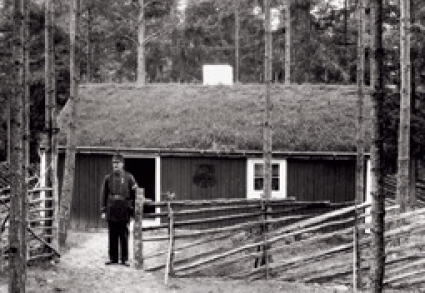
Småland soldier's croft.

When the Younger Allotment System was underway, they looked for a place in Åsenhöga Parish that was suitable for a soldier's croft and then Håkentorp's soldier's rote (Rote was when a farm or two or even up to 5 small farms had to take care of a soldiers croft and take care of the building and a few other things) was formed. Lerbacken was a natural place to have a croft as it was already a cultivated place. During the rest of the 17th century, the place is still called Lerbacken, but then came the first change in the name and it became Nybygget (Newbuilding), probably because they built new on the site. The new building was shortened a little later simply to Bygget (Building or buildingsite).

Who then settled on Lerkullen / Bygget after it became a soldier's croft? From the time the Younger Allotment System was established in 1682, it took until 1686 before a soldier was appointed at Lerbacken. It was a Måns Persson who was a soldier between 1686 and 1692.

The second soldier was Pähr Jönsson. I have found out quite a bit about Pähr's life.

He was probably born in Hestra around 1668 (do not know if it was north or south). On 6/11 1692 he married Ingrid Andersdotter from Valebo in Åsenhöga Parish. In the same year he became a Allotment System soldier for no. 123 Håkentorp. 1694-11-03 the first son Nils is born and 1697-06-29 the son Anders is born. In the same year, 1697, he accompanied his company, the Lieutenant Colonel's company, to the garrison in Wismar. Jönköping's regiment then exists as one of the troops in Wismar. 1700 the companies are changed and Pähr is transferred to Gustaf Ernst Rothlieb's company and is named there as no. 44 Pär from Håkentorp. Until June 1702, there are archives from the troops in Wismar and Pär is still on duty. It has now been 5 years since he left home.

During the summer of 1700, the regiment participated in the campaign in Holstein. After that they were in the garrison in Wismar. Between July and August 1702, the regiment marched from Pomerania to western Poland where they were united with the Swedish main army under Charles XII. The regiment participated i.a. in the siege of Thorn during May to October 1703. During the winter of 1703/04 they lay in winter quarters in Prussia. During the summer of 1704, they rejoined the main army. From 1707 until Poltava, they were always part of the main army. They witnessed the battle of Malatize on August 31, 1708 when the regiment was attacked by two Russian dragoon regiments while setting up camp. They bravely defended themselves and managed to hold out until reinforcements came to the rescue. However, the regiment lost many people in this battle. Even in the Battle of Wiprek on January 7, 1709, the regiment lost many soldiers. At the Battle of Poltava on June 28, 1709, the regiment was formed only by a battalion of about 300 men. The battle was the end of the regiment, two-thirds of the crew, including all but one officer, were wounded or killed. Pähr was one of the soldiers who survived all battles and so did Poltava and went into captivity in 1709.

After the peace of 1721, he returned home on April 16, 1722. He stands as the 8th soldier in the roll over returning prisoners of war. The small group of returning soldiers consisted of only four men. Between February 1722 and January 1725, only 49 prisoners belonging to Jönköping's regiment returned home from captivity. If I remember correctly, the regiment consisted from the beginning of 1200 men. About Pähr it says in the prisoner of war roll: Kväst in the right leg, dismissal with maintenance, 54 years, 30 years of service. Kväst is that he is injured in the right leg and has thus limped from captivity to the boat that took them to Stockholm where they landed as it says in the roll. I have not yet found any signs that he was taken back to Åsenhöga parish and saw Ingrid Andersdotter or any of their sons again. 1724-09-03 the eldest son Nils has his first child Märit and 1726-12-22 the son Anders is born. Pähr is not a godfather. Pährs grandson Anders later also became a soldier named Kullman. At least half of Åsenhöga can count Pär as their ancestor.

Others that took over 123 Håkentorp: 1709-1713 Anders Andersson

Participated in the battle of Helsingborg, probably disappeared, possibly a prisoner of war in Germany 1713 or 14

1716 -1718 Nils Larsson, died during the retreat from Norway 1718.

These two were unmarried and Pär Jönsson's wife Ingrid Andersdotter lived there. Ingrid Andersdotter at Lerbacken is mentioned in the church accounts in 1718.

1719-23 Tore Persson Moberg 40 years, after that the rote is vacant.

1730-39 Johan Torsson

1740-42 Lars Moberg. Married. Commanded to the galley Dyker 1741-42, died in Finland, probably dysentery 8/10 1742.

After Lars Moberg had died, a man named Assar Zachrisson came and took over. He was recruited on January 17, 1743 and he too was given the name Moberg but was not related to Lars. Assar was born in Åkers Parish, more precisely in Soldattorp 102 Sneppabo under Grytås rote on August 29, 1722. This is where we get into my family. Assar Zachrisson Moberg was my great - great - great - great-grandfather. According to the General Pattern Roll, Assar was 170 cm tall. It was not long after he had been recruited that he had to go into battle. On May 20, 1743, he took part in the battle of Korpoström in what is today Finland and they fought against the Russians in what has come to be known as the Hattars' Russian War (Hattarna was a Swedish government party that ruled Sweden at this time). The battle was over in just a few hours and it was the Russians who had won.

1750 it says that the hometown was Bygget after having been Lerbacken before, but there are slightly different descriptions in different church books about when the name was changed.

1751 is the peace command in Kristianstad in Skåne and so also the following year, 1752.

In 1756, the so-called Seven Years' War was started between the great powers Prussia and Great Britain-Hanover on the one hand and Austria, France and Russia on the other. Denmark and Sweden were initially outside the war. It was on Danish initiative that the Swedish parliament pushed through a Nordic act of neutrality, which was intended to keep both Denmark and Sweden out of the war. The two dominant parliamentary parties, the Hat Party and the Cap Party, had agreed that peace should be maintained. By invoking a 108-year clause written after the Thirty Years' War in 1648, by the Austrian Empress Maria Teresia, Sweden was eventually drawn into the war and on September 13, 1757, 20,000 men withdrew from Sweden (including Assar Moberg) against Pomerania.

The Swedish army was not very good at this time as most of the soldiers lacked training and combat experience. On February 6, 1759, Assar was in Stralsund in Pomerania and on November 17, the same year, he was in Wolgast in Pomerania. On November 20, 1761, he had come to Grebox in Pomerania. He witnessed the entire Pomeranian War, which ended in May 1762.

In 1766 there will be a peace command in Kristianstad again and in 1774 another peace command and then through a camp in Skåne.

The second of November, 1785, he is removed from his duties. He requests and receives dismissal and additional maintenance. Assar is then 63 years old and has served for 42 years.

Assar had several children just like so many other soldiers but the sons he had died early so there was no one to hand over the croft to. Not right then at least. It was so that his youngest daughter Walborg was pregnant but she was not married, which did not looked at kindly at this time. The father of the child was named Jonas Svensson and he took his responsibility and married Walborg on the 4th of December 1785. Exactly where Jonas comes from has not emerged from any sources. It only says in the General Pattern rolls that he is "Smålänning" (from the lanscape of Småland). Many have searched but no one has yet found him anywhere before he shows up and marries Walborg. Jonas, who was 203 cm tall, would be the new soldier at Bygget. On December 8, 1785, 4 days after he had married Walborg, he was accepted as a soldier and his soldiers name becomes Lantz. During the Russian War (1788 - 1790) he injured himself and ended up in 1789 at Kristinestad Hospital in Finland. Jonas continues as a soldier despite the injury.

General pattern roll from 1807 with Jonas Lantz.

After Jonas had participated in the Russian war, he had to go to Stralsund, where his father-in-law Assar had fought in the 1750s and 1760s. During a general muster in Stralsund in 1807, he was promoted to Vice Corporal. It is thus during a burning war that he is promoted. This war that takes place has a number of different names, the Pomeranian War which took place between 1805 and 1807 but also the Swedish-French War which took place between 1805 and 1810. It is also called the First Napoleonic War and the German War. The war against France raged until January 6, 1810 when peace in Paris occurred and France was declared the winner.

Jonas retires as a soldier on December 19, 1812. He dies on February 14, 1825.

The son that Walborg was pregnant with when she married Jonas was born on March 28, 1786 and he was named Johannes. Johannes was slightly shorter than his father, who was 203 cm, and he was "only" 184 cm or 5 feet 11 1/2 inches as it was written at this time. Even though Johannes was the eldest son, he did not take over Bygget after his father as Jonas was still a soldier when Johannes was recruited on January 20, 1806. Johannes was instead allowed to take over croft 125 Ingarp which is not more than a few kilometers from Bygget. He was also involved with some things during his time as a soldier. He was in Skåne 1808 and 1809, on Gotland and in Västerbotten (Ratan) 1809, work command in Malmö 1807 and 1810, at garrison in Karlshamn 1811-12, whereupon in 1811 "got a hernia in the left groin while helping with the transport of banknotes from a ship" ; in Germany and Norway 1813-14, work command at Göta canal 1816, 1820, 1828 and 1832, at Vanäs fortress 1825; dismissal with registration for maintenance at the General Muster 1834, served excellently well, war merits and received damage have justified maintenance before achieved 30 years of service, 48 years, 28 years of service.

A little curiosity that may be a little interesting is what he did after his service as a soldier. Two crofts have belonged to the farms in Trollsebo. Under Västergården, Trollenäs, also called Laxabo. Certainly no more than one family has lived here. In the 1830s, Johannes Lax and his wife Stina came from the soldier's croft in Ingarp. Lax had after well-done military service, i.a. had he been in France against Napoleon, requested and dismissed. At Trollenäs he built a cottage and barn, as well as cultivated fields on a rocky and miserable land. It is said that Lax used to invite the youth of the area to help him with the cultivation. As payment, the young people received food and spirits and, presumably, stories from Lax's Soldier era. In 1844, the parish's "elder" looked at the cultivation that Lax had accomplished from the entrance of the croft until now. For his cultivation he received 241 riksdaler and a mention in the parish protocols. Lax was born in 1786 and died in 1876. When he was buried in Åsenhöga cemetery, the parish soldiers formed a hedge and saluted at the grave. The widow remained until 1893.

Since Johannes got his own croft and another soldiers name, the question is who took over Bygget after Jonas Svensson Lantz? The answer to that question is Sven Jonasson, Jonas and Walborg's fifth child. Sven, who was born on October 27, 1796 (10 years younger than his brother Johannes), was only 16 and a half when he was recruited on March 3, 1813. He gets the soldiers name Lantz as his father. Sven Lantz belonged to those who were with the then Crown Prince Karl Johan (Bernadotte) during the battle of Leipzig in 1813. After that, they had to march down to Brussels before it was time to head home. Before it was time to go home, they had to take a walk up to Oslo to persuade the Norwegians to at least half become Swedes. One of Lantz's group of friends was named Lars Fhyr, he later changed his last name to Löv. He served for 131 Hyltan. He was born on the croft Björkekullen, which was not far from Bygget. They are said to have known each other during childhood and adolescence.

He was commissioned to work at Göta Canal 1815, 1816, 1820, 1828, 1832, at Trollhätte Canal 1840, at Vanäs Fortress 1826 which is today called Karlsborg Fortress, dismissed with registration for maintenance at General Mönstringen 1850, served excellently well, 54 years, 38 years of service . Sven is thus the one who has served the longest at Bygget after his grandfather Assar Moberg who served for 42 years. Sven was 5 ft 9½ h or 176 cm.

Now it was time for a new change of soldier at Bygget. The eldest son, whose name was Johannes, just like his uncle, had already on 13 November 1841 been accepted as a soldier at 134 Törestorp. The place where the croft was located was named Flinkabo after a soldier who lived there in the 18th century. Johannes was not so short but was 6ft 1h tall or about 185 cm. He was commanded at the city garrison in Malmö 1844, in Skåne 1848, in Schleswig 1850 (Germany, near the border to Denmark), on Gotland 1854, at Karlsten fortress 1858, at a camp in Skåne 1860, died 17 Dec 1871, 51 years, 30 years of service . In addition to being a soldier, he had been a tailor. In the 1850s, there was a wolf in Åsenhöga Parish and it is said that during a search it was Johannes who shot the "last" wolf.

Who then took over Bygget when the eldest son had another croft and the soldiers name Ros? Well, it was actually the youngest son and 8th in the group of children which consisted of 9 children. His name was Jonas, just like his grandfather, and Jonas also got the soldiers name Lantz, just as his father and grandfather had before him. Jonas was slightly shorter than his brother Johannes and was only 180 cm. In 1854 he was commanded on Gotland just like his brother. 10 years later, ie 1864, more precisely on the 14th of May Jonas is promoted to Corporal and on the fourth of July 1878 he is promoted to Distinction Corporal, which was the highest non-commissioned officer at this time and can be compared to Furir (Sergeant after 2009). Distinction corporal was originally a rank of honor, but over time it changed and eventually became a rank of its own. Jonas was a tailor just like his brother Johannes.

Being a corporal was then as now a group commander. A corporal in the 19th century was a group commander for a parish approximately where there were about 10 - 12 soldiers. One of the tasks was to teach the soldiers to shoot, which made Bygget a gathering place for the parish's soldiers for a while. Jonas was one of the soldiers who saluted at Johannes Lax's grave (Johannes was Jonas' grandfather's brother). On June 25, 1881 (a Saturday and Midsummer's Day), Jonas resigned and received it with a report for maintenance. He had served excellently well during his 31 years as a soldier. He was then 50 years old.

Bygget as it looked in the early 1920s.

It was now time to hand over to the next man and as we have become accustomed to it being one of the younger abilities in the family who took over before did not happen this time. It was the eldest son (not the oldest in the group of children though, but second in the order), Sven Gerhard who got the honor to take over. He was not 20 years old (born September 24, 1861). He was part of the General muster at Västra Lägret in Skillingaryd when his father asked for resignation and at the same time Gerhard was also accepted. In the military, he was called Sven Lantz as his grandfather, but in everyday life it was Gerhard that he was called. Of Gerhard's brothers, no one else became a soldier. Three of his siblings emigrated to the United States in the late 1880s and early 1890s. Gerhard was not a tailor to the profession like his father, but he had been trained as a carpenter at Mäster Malm in Törestorp, where he started as a 15-year-old.

Bygget during the 1930s. Nisse on the left and his brother Oskar (Leonard) on the right.

Gerhard would be the last soldier at Bygget and the era with the Allotment System soldiers would end. 1901 was the last year when the Allotment System existed and conscription was introduced, but there were actually some old soldiers left after the Allotment System ended but not at Bygget. On April 7, 1896, Gerhard was fired due to illness. The era was thus over and there had been soldier at Lerbacken / Bygget for 210 years. What kind of illness Gerhard had at this time is not clear from the documents. There were many old soldiers who got the chance to buy out the crofts they had had during their time as soldiers and six years after Gerhard had been fired, the contract was written and the croft was thus his and his wife Emelie's. There were changes at Bygget after this. In 1907, Gerhard built his own workshop so that he could work a little better with his furniture. In 1910 it was the barn's turn so that it became a little bigger than the one that had been there when he was a soldier. After this, no major changes took place until 1927, when the croft that Gerhard had been a soldier in during the 15 years was demolished and now a two-storey house was built a little behind where the croft had stood. When the house received electricity is not clear at the time of writing, but in 1931 electricity was drawn into the workshop. Gerhard was now 70 years old and it was noticed in the local press. He still worked as a carpenter but it would end in 1934 when he was 73 years old. It was the youngest son Nils "Nisse" Lantz who would take over now and continue to operate at Bygget as a carpenter and he did so far into the 1970s. Nisse died in 1983, 80 years old.

Bygget 2018.

During the late 1990s, Bygget was sold by the last Lantz descendants who lived at Bygget and then one and the same family had lived here for over 250 years and there had been various activities here for centuries. There are many who usually try to follow the history of a house to see who has lived in it and to see how it has changed over time. The first memory I have from Bygget was when I was six years old. It was my grandfather's brother Oskar or Leonard who some knew him as when he turned 90 and it was 1980. You who have read this blog before know that I have visited Bygget a few times in recent years and of course it has changed since the beginning of the 80's, even though the house looks the same and that it is the same color as then, it is all around that it has changed.

It has actually been fun to find out a little about who has lived in one and the same place through the centuries and find out what they have done. You understand the history of the place in a completely different way and you find out a lot about Swedish history and much more. Of course, there is still a lot to learn about the places, but it may be at a later time and maybe a new post here in the blog about it.

//Daniel

Tuesday, April 13, 2021

Easter witches

It's been a while since I wrote here in the blog and thought it was time again. I have previously written a bit about Christmas and its traditions. Since it has just been Easter, I thought it might be a little fun to find out a little about one of the Easter traditions that has to do with witches. Follow the course of history and find out where the Easter witches come from.

Easter witches 2008 and 1958. (Photo: Holger.Ellgaard, own photo montage - self-made (2008), family archive (1958))

Easter witches traditions

We dressed up as Easter witches as children, our children and grandchildren dress up as Easter witches and it's great fun - but where does the tradition come from? Why do we dress up? When did this custom begin?

Easter bitches, Easter bitch or Easter witch, is according to old Swedish folklore a witch who flies on her broom to a place called Blåkulla, on Maundy Thursday or the night between Maundy Wednesday and Maundy Thursday. On Easter day, the witches will return to their homes.

The word Blåkulla itself, is believed to be a Swedishization of the German word Blocksberg which is a home to Satan according to legend. Before, blue also meant black and Blåkulla then also meant Svarta Kullen.

History

It is uncertain how the idea of ​​Easter witches began, but it is believed that it comes from the 17th century witch accused. In the 1660s and 1670s, witch trials took place in Sweden and hundreds of women were executed after being accused of going to Satan's banquet. The banquet would have been held in a magnificent courtyard in a place often called Blåkulla. The "witches" who flew there on their brooms thought that lots of delicacies were served, but what they really got were frogs, snakes and toads.

It was thought that the witches went to Blåkulla on a broom or some kind of everyday tool, or sometimes on a pet. It was assumed that the witches could get through walls to get to Blåkulla and they could open a hole in any wall with the help of a needle, large enough to get out on the other side.

The witch sometimes took a child with her to serve Satan. A story from a child that they had been abducted to Blåkullla was enough for a witch to be killed in the witch trials and burned as punishment.

When the witches spent time at Blåkulla, the surroundings could not notice that they were gone, but it was as if they were still in their usual place.

Fully equipped for the journey to Blåkulla, the lady with the broom is ready for Easter.

People wanted to scare the witches away and to do that they lit fires and shot with rifles. Today, this remains in the form of Walpurgis Mass bonfires, may fires, Easter crackers and rockets. All brooms and garbage brushes were also hidden in the houses so that the witches would not take them and use them as a means of transport to Blåkulla.

But Easter witches are not at all the same as the witches believed in during the 17th century. Easter witches are based more on folk beliefs. For example, witches had accessories such as a coffee pot, a black cat and a broom and these have no direct connection to the witches of that time. In the 17th century, coffee was not drunk in Sweden and black cats are not mentioned anywhere from the documents of that time.

During research on the subject of Easter witches at the time, several people born between 1840 and 1870 have said that the tradition of Easter witches is "old" or "before my time" and that it was very "common in my parents' time".

Tradition

It is not known for sure when the tradition of dressing up as Easter ladies began in Sweden. In the middle of the 19th century, the custom already existed in western Swedish cities, so the first Easter witches are probably from the beginning of the 19th century or even earlier. Easter witches, who were initially adults and young people, who smeared their faces with soot and walked from house to house on Easter Eve. This started in Bohuslän, Dalsland and Värmland

Later, the tradition spread and it also became something that children did and had fun with, and smaller and smaller adults and young people dressed up.

Kids dressed up.

Both boys and girls dressed up and still do today, sometimes they dress up as Easter men with mustaches and hats or maybe Easter witches or chicken.

They walk around the houses and knock on the doors, wish a happy Easter and sometimes hand over small gifts such as Easter cards that they have made themselves.

Kids eastercards.

In Finland, children give away willow twigs when in eastern Finland it was believed that these twigs chased away evil spirits and that they also gave blessing and health.

Those who receive these small gifts from the children in return give a thank-you gift consisting of sweets or small change and which the children collect in a basket or coffee pot.

Local traditions

In Visby, a public Easter event is held every year, where adults also dress up as Easter witches and hand out Easter eggs.

In Värmland and Dalsland, you go to your acquaintances, open their door and shout Happy Easter at the same time as you throw Easter cards and sweets into the home.

In some places in Sweden, a straw doll was made that looked like an Easter witch, which was then burned up on Easter Eve.

Some places that have been called or are called Blåkulla:

  • It is believed that the island Blå Jungfrun (sometimes called just Jungfrun), between northern Öland and Oskarshamn, was this place called Blåkulla.
  • Blåkullen or Blåkulla on Brattön in Marstrand is also a place that the witches were thought to go to.
  • The blue million program houses in Hagalund in Solna municipality are also called Blåkulla.
  • Västra Laholm's housing municipality is called Blåkulla.
  • Visby's police station has been called Blåkulla.
  • Blåkulla gård is a riding school and farm in Västerhaninge south of Stockholm.

Feel free to tell me about your Easter traditions! Do you have pictures from when you dressed up as a child? Feel free to share with me!

//Daniel

Saturday, December 26, 2020

Christmas in the Swedish countryside a 150 years ago

After a few difficult years of famine, you could finally celebrate Christmas again. I have taken a closer look at Christmas traditions and superstitions - and tell what Christmas in a small farmhouse could look like in the 1870s.

150 years ago, neither Christmas tree decorations, Advent candlesticks nor Santa Claus were known in the Swedish countryside. They fought for bread and were happy if there was food on the table. But even in the simplest crofts, Christmas was still a big holiday that was celebrated properly.

In the past, it was a disaster if the harvest went wrong. In the late 1860s, it was a period of severe crop failure when people and animals starved. That is also why many broke up and sought happiness in America. Those who remained were to work hard to survive. You did not know the kind Santa Claus in a red hat - but that there was a small strict garden gnome, you knew that.

The garden gnome would be kept happy

In the autumn, the working days were particularly long and heavy. Potatoes and beets would be harvested, firewood cut, the animals fertilized extra and the soil plowed. The threshing was finally done, and it was important that everything was finished before Christmas. On December 21, the garden gnomes contract expired and then he did not want to guard the grain anymore. Christmas was associated with a lot of magic and superstition - therefore it was important that everything was taken care of properly.

In the last weeks before Christmas, the household was in full swing. The slaughter was an important part of the Christmas preparations. They took advantage of almost everything and made sausages, press jam, lung puree, blood sausages, flatbread and much more. Light was cast from the tallow from the slaughter, and the membranes were stretched like "glass" in the lanterns. If anything from the pig was left over, it was buried under a rock so that the yard gnome would be kept happy.

For Christmas, you should be extra kind to the animals - otherwise the garden gnome got angry.

Christmas beer was brewed and lye fish was soaked

Christmas beer was brewed from wort and hops. And so that the beer would not be enchanted, it was important that everyone cheered and shouted "hello funny" as loud as you could when the yeast was put in. On Anna Day on December 9, the lye fish would be soaked and the beer ready to be tasted. It was to be celebrated with a real party - "Anna with a jug" as they said. Generosity has always been associated with Christmas, and housewives gladly went with a basket of food and bavirages to the poorest in the parish.

The Christmas baking could take several days

The week before Christmas went to the big bread baking. It took several hours to light the baking oven and it was a heavy job to beat and knead the large doughs in the wooden trays. The doughs were then left to rise on the stove heat before being baked into loaves or flat cakes. The big Christmas bake could last for several days and was strenuous for the women of the house. It was not uncommon for over a hundred kilos of flour to be used, and fermented rye loaves were made from it, which could weigh six kilos each.

Depending on where in Sweden you lived, for example, everyday bread, wort loaves, sour loaves, hard bread cakes, party bread and flatbread were baked. And to make the loaves extra good, they were brushed with juniper syrup. Pretzels, wheat bread, lynx cats, almond mussels and gingerbread were a luxury that those who were a little better off could treat themselves to.

It was not only in the bakery and the barn, that the work was in full swing, also in the stable and the village house there was feverish activity so that everything would be ready for Christmas.

Christmas straw is spread on the floor of a cottage in 1903.

Major cleaning on 23 December

To enter a farmhouse, you had to bend your neck in the low doorway and lift your feet over the high thresholds. Inside it was dark because the windows were small, and the walls were black with soot - only the hearth lit up. The day before Christmas Eve, the entire yard was to be cleaned. Because they burned in an open hearth, had animals indoors and did not clean as often, the dirt was hard and the smell was intrusive.

Tin plates, candlesticks, copper kettles and other fine items that were available would be polished and highlighted. Painted bonades with religious motifs were hung on the walls.

Christmas tree with apple instead of Christmas tree

The custom of having a Christmas tree indoors had not yet reached everyone in the countryside. Instead, they had Christmas trees on the table - a large wooden candlestick with sticks for apples. Outside the cottage, a spruce twig was placed, which meant that Christmas peace would prevail. Spruce needles were also scattered around the houses. It would protect against ghosts and other evil forces - it was thought that they were barefoot and that stinging spruce needles would stop them. One last remnant of this is that today you put spruce twigs to dry your feet on outside the front doors for Christmas.

Christmas bath and straw on the floor

For Christmas, it was a tradition for everyone on the farm to take a bath indoors in a tub. Then you warmed yourself in front of the fireplace before putting on your finest clothes. The men were to be cut and shaved before they were ready to celebrate Christmas. A Christmas sheaf of oats was to be set up for the birds before twelve o'clock on Christmas Eve.

In the simpler homes, it was still common to spread Christmas straw on the floors indoors. It was a special ceremony with the men of the farm carrying in sheaves of straw. The father of the house took the lead, he greeted and asked if his entourage could stay over Christmas. Mother in the house replied that it was going well, and offered them Scandinavian vodka and a sandwich.

Before Santa Claus took over the Christmas gift distribution, it was various Christmas games and pranks with disguised goats and other things that mattered.

The Christmas goat came with the presents

Both children and adults played in the straw, and overnight guests could sleep comfortably on the floor. They also took the opportunity to braid wreaths, trestles, stars, chandeliers and other nice things. In the straw, chickens, piglets and other small animals that were allowed to stay inside in the cabin heat in the winter also thrived. On Christmas Eve, everyone gathered for the most solemn meal of the year. They also set the table for friends and relatives who died during the year.

When there was a loud knock on the door, everyone knew that it was the Christmas goat who wanted to enter. He was dressed in fur and handed out Christmas presents to those who had been kind during the year. He had big horns, a bushy beard and a cane - no wonder the children were scared!

Fresh food on the Christmas table

The Christmas food was just as long-awaited whether you lived in a castle or a hut. When the Christmas food was served, bread and pork were the most important. But along the coasts there was also smoked eel, butter-fried perch or boiled pike on the Christmas table. A pigs head, ham, body cakes, kale, lye fish, liver pate, pork sausage, jam, palt, porridge, cheese and herring were other common delicacies. The unusual thing was that it was fresh food as a change to the salted, smoked or dried food that was eaten everyday.

Both family members and servants received a "Christmas pile" consisting of bread, and sometimes also cheese, butter, gingerbread and apple that would last all Christmas. The good Christmas food was swallowed with beer and Scandinavian vodka.

It was also important to share. Those who had the opportunity traditionally gave meat, soup, bread and candles to those in need in the parish. The farm animals also got a little extra food and care. The Christmas table ended with eating porridge from a large common bowl. No one was allowed to taste until they had made up a rhyme, and the spoon wandered around.

Shooting in Christmas to scare away trolls

After the porridge, everyone gathered for a Christmas act where the Christmas gospel was read out. They then sat for a long time and played cards, talked and told ghost stories. When dusk fell, it was time to "shoot in Christmas". Then the men went from farm to farm and fired shots outside the cottages. They were then drawn and given vodka before walking on. The custom was to scare away trolls and other evil beings.

You couldn't get to bed too late - on Christmas morning it was time for Christmas Mass. Each house had left home-made candles for the church, which was fully lit at six in the morning. People rode sleighs pulled by snorting horses in the cold winter morning. The snow creaked, the Christmas flare shone, the bell wreaths rang and the servants of the drivers shouted. The journey was also surrounded by magical rites to keep the trolls away. It was certainly an exciting experience for both adults and children.

Pretzels and vodka on the road

Some had a much longer journey than others and pretzels and vodka were sometimes brought as travel food. The heated church shone with light and was filled to the last seat. In the houses along the road from the church, the candles were lit in all the windows.

After the Christmas party, dinner was served at home and then Christmas peace reigned without any work. You were not even allowed to shovel snow or suede in the barn - it would bring misfortune. I believe that many took the opportunity to stretch out in the straw on the floor to braid Christmas goats and play with the children!

I wish you all a Merry Christmas and a very happy new year!

//Daniel

Monday, November 16, 2020

Commerce in Sweden, Part 3, The trading stalls

The rural trade changed lives

Countryside store in Glava in Värmland around 1912.

During the second half of the 19th century, countryside traders became more common. Here you had most of what was offered on the Swedish product market of that time - from spices to utensils.

It was the smells and odors older people, who in the early 1940s were interviewed about the countryside trade in their childhood and youth in the 19th century, best remembered. The smells of kerosene and turpentine, salted herring and dried fish were perhaps not so pleasant in themselves, but they went up in a symphony of fragrance from other goods: spices such as cinnamon, cardamom and coriander, new cotton fabric, school leather and celery, coffee and cigars .

In the spring, the open seed bags with clover and timothy gave a foretaste of the coming summer, and in the autumn candles from Liljeholmen gave a taste of the Christmas atmosphere.

The countryside shops began to emerge after the business freedom reforms of 1846 and 1864. The great expansion came in the 1870s, and continued during the 1880s. In 1890, there were about 9,000 rural trade movements in Sweden.

It happened that farmers opened a shop at home on the farm, but most shops started where people used to meet: at an important road junction, at the church or at a railway station.

The connection between the expansion of the railway network and the emergence of new rural business movements - two lines of development that coincide in time - is clear. It often gave a good start for those who wanted to establish trade to start selling food, snus (moist snuff) and spirits to the rallies at a railway construction. When the track was completed, the location at a station became ideal. People and companies moved there, and it was easy to get goods home by train.

In the trade stalls in the countryside, there was most of what was offered on the Swedish goods market of that time, including tools for agriculture, tools and household utensils. If something was missing, the trader could usually "take it home".

Fabric and yarn were included from the beginning. Clothing such as trousers, shirts and blouses, vests, mens and womens coats, made their entrance in the last decades of the 19th century. The same was done by factory-made shoes, rubber boots and boots.

But it was the basic goods that were important in all households, such as flour of various kinds, groats, sugar, salt, salted herring and coffee that dominated the purchases and accounted for the largest turnover in the stores. All such was sold in bulk. The trader or assistant weighed up and wrapped in cones or wrapped paper. It was one of the professional requirements for a sales assistant to be able to make such tight paper cones that they did not even let water through.

Even spirits were usually sold in "loose weight" until the 1880s. The spirit was measured in jugs, which held almost two liters. But you could also buy half and quarter jugs. The customer had to bring bottles or other containers himself.

Goods ready in packaging from the factory, arrived later. The same applies to products marketed under a particular brand name or brand. Tobacco, snus (moist snuff) and cigars were among the first to go on sale under special brand names. Towards the end of the 19th century, there were about ten different snus (moist snuff) brands to choose from.

Fresh produce such as vegetables, fruit, fresh meat, fresh fish and milk were only sparse. It was too difficult to store before the time of the refrigerators and freezers. In addition, many had access to such on their own farm or plot. Others could buy or exchange with neighbors.

The trading stall was often also a post office and newspaper office, and a meeting place in general. Especially on pay days with many men in the store, it could be lively. Liquor consumption was not allowed inside, but you could always do it outside around the corner. The scales' five- and ten-kilo weights were used for strength tests, lifted on the middle finger and swung around with the grip between the thumb and forefinger.

The era of the old-fashioned countryside trade lasted for about a hundred years. In the decades after the Second World War, the customer base in the countryside was thinned out through the increased relocation to cities and towns. Many who lived in the countryside got a car and started shopping in the town's supermarket, where they themselves picked up factory-packaged goods from shelves, refrigerators and freezers. The small countryside traders could not keep up with that development. The investment costs of modernizing the stores had become too high in relation to the low turnover. One countryside store after another was closed down, missed by many, even those who themselves did not shop there so much towards the end.

//Daniel

Sunday, November 15, 2020

Commerce in Sweden, part 2, The Trots

The Trots
Nasaren, Painting by Pehr Hilleström (1733-1816)

In this blogpost I've taken the freedom to write the swedish slang as it was used in Sweden back in the days and I have tried to translate it into the closest words in English. You will see both the Swedish and the closest English translated words in here.

Something that the Swedish people often get wrong is in they go to a marketplace (old market) and say: "Ser du alla knallarna på marknaden?" (Translation: "Do you see all the trots in the marketplace?") refering to the market stalls and the poeple who sells things there but the are not really "knallar" or "trots".

Hardly any farm in Sweden's elongated country was too small or too lonely to be visited by a farm trader. The walkers, as they were also called, usually came once or twice a year.

The farm people flocked around the merchant as he spread his goods in the house or on the trolley. The women thumbed on fabrics, held them in front of them to see what they would look like skirts or aprons. The men turned and turned on bowls and tin plates, tapped them to listen to the quality, felt with their thumbs on knife edge. Children were discouraged so as not to stain the trappings. Prices and qualities were negotiated.
Most farm traders came from Sjuhäradsbygden, ie the seven districts Mark, Kind, Ås, Redväg, Veden, Bollebygd and Gäsene in southern Västergötland, and were therefore called "Västgötaknallar".
The term "Knalle" has been given various explanations. The closest is probably the word "trots" which is synonymous with walking, still alive in expressions like "Det knallar och går" = "It walks and goes" or "Jag ska knalla hem" = "I'm going to trot home". In their own secret language, Månsing they called themselfs "Nasare" and to sell "nasa".

Had a secret language

Far back in time, in some cases even today, slang words are used that have long since been intercepted from the secret language of the Västgöta trots. Some examples; fika, fjälla (girl, fiancée), snut = copper (old english word for cop) (police), snuthäck (police station), borst (shot), karda (hand), snok (nose) and tjacka (buy). It is one of two old and long secret languages, which differ so much from normal Swedish that they can be seen as their own languages. The other is the chimney sweepers "knoparmoj".
One reason why the Knallars developed their secret language was that they could consult with colleagues or any accompanying tradesman about goods, prices and qualities, without revealing trade secrets to outsiders. Therefore, månsing contains a lot of arithmetic words and expressions for money. Two examples that are still "Stålar" (Something like dibs, money) and hacka (Tjäna sig en hacka in Swedish is making a little extra money from something).
We do not know for sure what the word månsing comes from. Some believe that it is connected with the Västgötland dialect, where our speech organ is called the "månnen". Then speaking can be "månsa", and the language "månsing". According to another theory, månsing is related to the old word "måla", which meant to measure, still alive in place names such as Blomstermåla and Eriksmåla.
It is certain that the elongated cane that the trots used to measure fabric was called Måns.

The trots commerce had its origins in the early Middle Ages. The lean fields in Västergötland's forest areas did not provide enough grain to feed the population. Thus there was plenty of pasture, even in rocky pastures, meadows and forest clearings. This gave a surplus of cattle, which could be driven to the plains and exchanged for grain. Enthusiastic ox-drivers then also brought crafts and handicrafts of various kinds, made on the farm, to sell or exchange.
From being a sideline to ox farming, over the centuries handicrafts and trade trips grew into a main industry in the Sjuhäradsbygden, alongside agriculture.
The trips were extended to the whole of Sweden, for some also to Norway or Finland.

An early product was carved or turned bowls and wooden plates. The bowls were exchanged for the amount of grain that could be contained in them. Other early products were reeds and wool combs. But it was the textiles that came to dominate the trots assortment.
Wool and linen were spinned and woven in homes, and fabrics of various kinds filled the sacks of the trots. In the 19th century, imported cotton fabric became the largest product.
To begin with, when the roads were bad or non-existent, the trots went on foot with their goods in a double sack hung over their shoulders. Otherwise they split. It meant a large double sack was hung over a horse and the trot went next to it. In the 18th and 19th centuries, when road maintenance began to improve, the trots often rode horses and had carriages. Some had depot (a warehouse), with larger consignments within their districts, with employed trade servants to help them and they became "big trots" (merchants).

Over the centuries, the government made many attempts to maintain the cities' trade monopoly. The two towns in Sjuhäradsbygden, Borås and Ulricehamn, were added in the 17th and 18th centuries, respectively, mainly for this purpose. The trots would move into one of those cities and become citizens, it was thought.
Borås and Ulricehamn also got an emerging bourgeoisie, but the peasantry did not want to become city dwellers. Instead, their numbers and trade increased in the enclosure of the privileges of the two cities.
The Västgötatrots travel trade was controversial and a constant source of debates in the Parliment. Representatives of the bourgeoisie did not like the competition and demanded a ban. The priests agreed, but with moral, or rather moralizing, arguments. They believed that the sale of farm trades led to sinful luxury consumption and vanity, especially among women. Attempts were also made to regulate and restrict, but the people of Västergötland trotted as before.

Being a peddler was a dangerous profession. Both their stock and money were coveted booty for muggers, robbers and thieves. In church books and court books, there are many notes about trots that were killed on their travels. Some examples: In Borås church register for 1661 it can be read that Anders in Gethult and Erik Håkansson at Rönnebo were assaulted and killed by robbers. Johan Bergman from Borås was killed in 1773 in Östmark parish in Fryksände. Four years later, Toarp's church records testify that Anders in Andare was "murdered at Karlskrona". According to Ulricehamn's court book in 1833, the sales clerk Erik Medin had been found murdered in Hällefors and his books with written debts burned.

Almost all the trots were men. The few women in the profession traded in their homes or in the immediate vicinity. But women still played a crucial role in Sjuhäradsbygden's thriving travel trade. They were the ones who carded and spun the wool, woven and dyed the fabrics. And they were the ones who looked after the farms and the animals when the men were out on their trade trips.
The travel trade reached its peak in the 19th century. Many farm traders had then expanded their business and became big trots. The new means of communication, steamboats and trains, began to be used for the larger and longer transports. A new link was added in the production chain: Publishers who bought the raw material, outsourced manufacturing assignments to the weavers in the homes and delivered the finished products to the trots.
Beginning with the capital that big trots and publishers could collect, as well as centuries of tradition and know-how, Sjuhäradsbygden's flourishing textile industry emerged during the second half of the 19th century and the beginning of the 20th century. Borås and Ulricehamn became - alongside Norrköping - Sweden's leading textile industry cities.

By then, the conditions for the farm trade had also changed. More and more of the trade in the countryside passed to the country traders who established themselves around the country. The last Västgötaknallarna maintained their district's ancient tradition of travel trade until around the turn of the century 1800-1900.

//Daniel